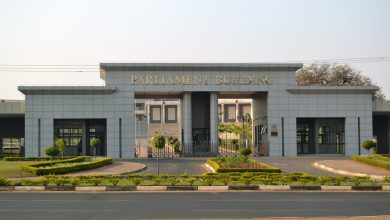
Government trimmed its economic growth forecast for this year in its annual budget on Friday as disgruntled citizens protested in major cities over rising prices.
The protesters are mostly led by street vendors who accuse the government of failing to control double-digit inflation, which they say is putting them out of business and disrupting livelihoods.

As their demonstrations have spread from the capital, Lilongwe, to the main commercial city, Blantyre, they have been joined on the streets by jobless youths unhappy with President Lazarus Chakwera’s government.
On Friday, Finance Minister Simplex Chithyola Banda said in his budget speech that the country’s economy was expected to grow 3.2 percent in 2025, down from a forecast of four percent given last December.
According to the Malawi 2063 national vision, the country’s economy would need to grow at an average of six percent per year to achieve the goal of becoming an upper-middle-income country by 2063.
However; some analysts suggest that achieving this target might require even higher growth rates exceeding seven percent annually to reach the desired development level by that timeframe.
Last year’s growth was estimated at 1.8 percent because of the impact of a severe regional drought that dented agricultural output, the mainstay of the economy.
Inflation was at 28.5 percent in January, driven higher by crippling foreign exchange shortages that have curbed imports of key goods like fuel and fertiliser and led to a thriving black market for foreign currency nationwide.
Banda said the government hoped to address the forex shortages by boosting production in sectors that could bring in dollars, like agriculture, tourism and mining.
He said a national anti-crime unit would be set up to crack down on the parallel market for foreign currency.
The current fiscal year’s budget deficit is estimated at 9.6 percent of gross domestic product (GDP), while next year’s is seen at 9.5 percent of GDP.
Public debt stood at roughly 86 percent of GDP in September 2024, and the government is continuing to try to bring debt-restructuring negotiations to a close.
“Government in principle has reached agreements with all official bilateral creditors and is still negotiating with commercial creditors to restructure debt,” Banda said.
“Once the negotiations are completed, the initiative will ease the pressure on foreign exchange and provide fiscal space necessary for productive investment.”